Circlo
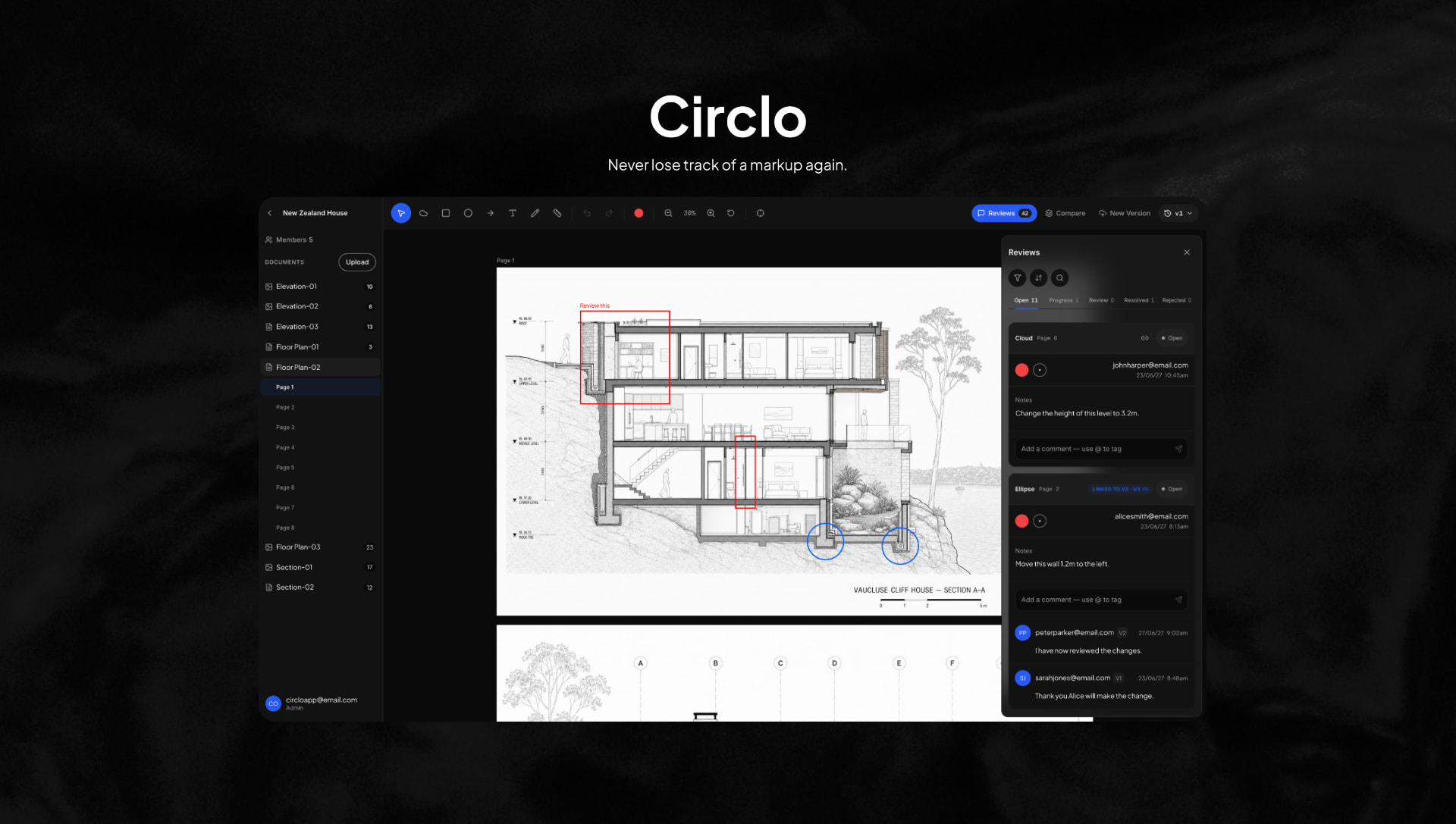
Circlo is a collaborative drawing review web application for AEC teams.
Circlo
Circlo is a collaborative drawing review web application for architecture, engineering and construction (AEC) teams. It centralises drawing review in one place — upload, markup, discuss, and carry comments across versions, instead of chasing them through email and disconnected PDFs.
Circlo is built with a modern, AI-driven development process, alongside my co-founder.
My Role
My role as Co-founder, Head of Product & Design includes:
The Process
Although the diagram suggests a linear progression, various steps were executed concurrently, forming a feedback loop that adapts and evolves based on new information and ideas as the product advances.
01. Identifying The Problem
In this project, we engaged with and interviewed professionals from the architectural industry to understand their workflow, daily pain points, current software and physical systems, and associated challenges.
The Problem
The primary issue we discovered is that most architectural practices heavily rely on email for design collaboration and communication. This manual process results in slow, inefficient workflows that are prone to human error. Below are the pain point themes identified.
After the main pain point themes were identified, we conducted surveys and interviews to further understand the priority of the pain points and to dive deeper into the problem areas.
Competitors
Existing architecture design collaboration applications are designed for large-scale complex projects, construction documentation focused. These applications and platforms are often overloaded with complicated project and company settings and features, making them inaccessible, and difficult to set up, learn and utilise for most users.
Identifying the User
It was important to identify the specific user group we aimed to serve, considering that different users have distinct needs. Based on our research conducted, we identified the market challenges and opportunities, we determined that our target users would be small to medium architecture studios.
02. Solutions Generation
After understanding the pain point users are having with their current systems, we initiated brainstorming sessions to generate product ideas that could address the issues. We broke down the existing business structures and workflows to identify inefficiencies and start to reimagine, design and map out workflows that a product could provide to enable a more efficient and simple process. Applications from inside and outside of the architecture, engineering and construction (AEC) industry were used as inspirations, the goal was to bring the efficiency and product design principle and processes of the tech industry into the architecture, engineering and construction (AEC) industry.
Below are the themes we have identified to generate solutions for:
03. Product Ideation
In the product ideation phase, we formalise the different high-level solutions we have generated, consolidating and discussing the merit and feasibility of each idea. Diagrams and wireframes, user flow maps were used to give the ideas a form for better discussion and collaboration. This process allowed us to pinpoint the area where we want the product to focus on, before getting into high-fidelity designs.
04. Product Market Research
As the idea of the product starts to take form, research was conducted to assess the product-market fit and explore potential market strategies. The following research and analysis were performed for Circlo to gain a comprehensive understanding of the app's potential, as well as the challenges and opportunities present:
05. Validating the Idea
To ensure the viability and alignment of our ideas with the needs of the architecture, engineering and construction (AEC) industry, we actively engaged in surveys and user interviews throughout the product ideation process. These interactions allowed us to discuss, prioritize, and validate solutions and ideas with professionals in the architecture, engineering and construction (AEC) industry. By gathering valuable feedback at this early stage, we obtained crucial insights into the desired direction of the product and used this information to shape our product roadmap.
06. The Problem Today
Reviewing revised drawings still means starting from scratch, every time.
07. Built with AI Coding Agents
Circlo was built with AI coding agents, working alongside my co-founder. Instead of a traditional outsourced team, the product was designed, built and iterated through an AI-driven development workflow.
This approach let a small founding team move quickly from idea to a working product, while keeping quality, documentation and performance in check.
08. The Workflow
09. Key Features
10. Who It's For
Circlo is free to use in early access, with early users' feedback shaping what gets built next.