Amity Communities
Amity is a communities platform to enable like-minded people to discuss trending topics, breaking news and live events.
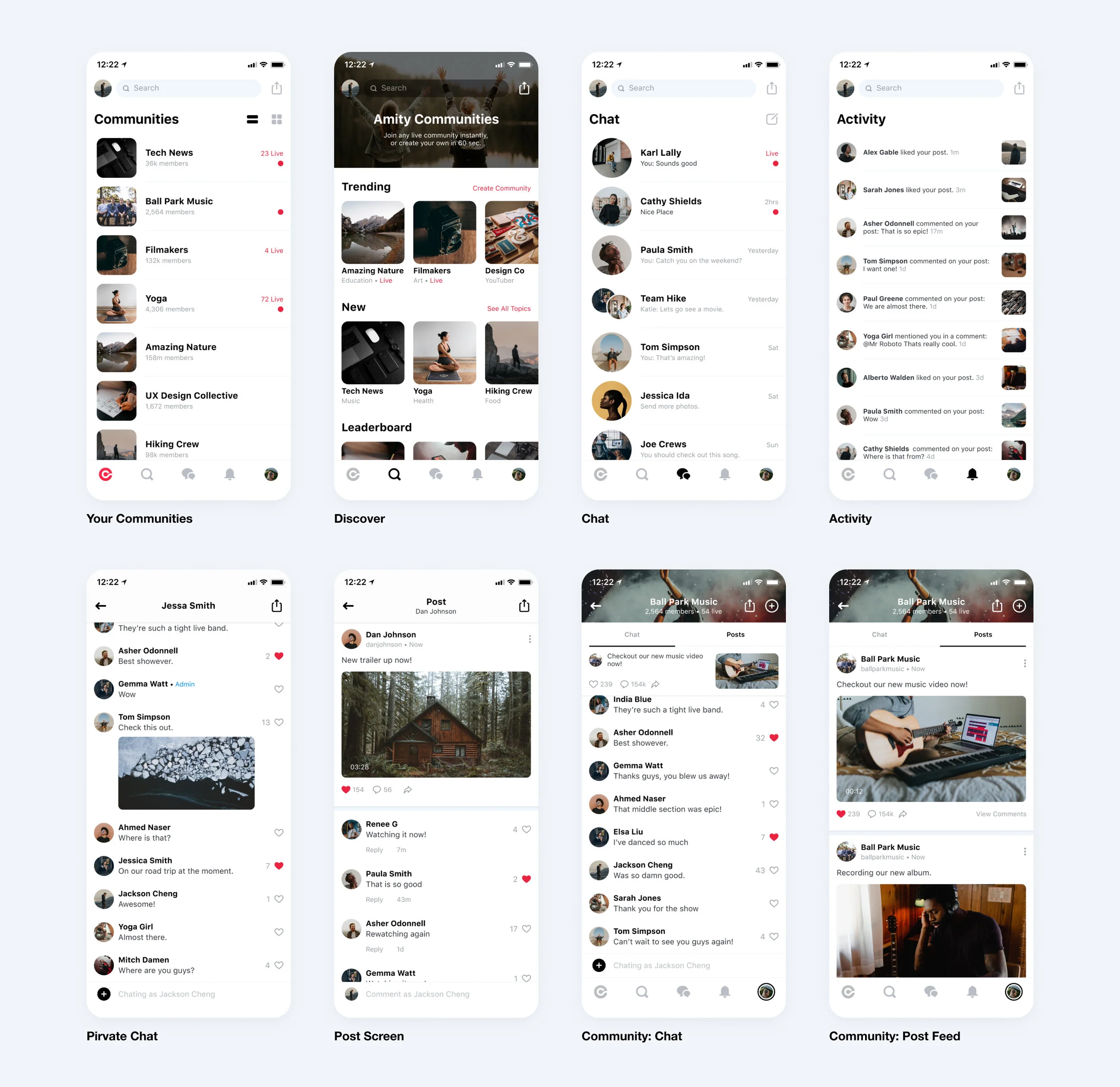
Highlights
Amity’s Mission
To make the world’s communities come to life and enable groups of people to come together to do extraordinary things.

My Role
My role as the Head of Product Design (Product Management), includes product design direction and product management, bringing the product from ideation to production. I worked with the product, design, marketing, and engineering teams to ensure product design solutions aligned with product vision and business strategy.
My day-to-day included:
The Problem
Businesses, influencers, artists, YouTubers, brands, news publications, content creators are facing challenges engaging with people via traditional social networks with unpredictable reach, minimal engagement, and expensive costs.
Solution
Amity is a platform for communities to come together around the world. It allows anyone to instantly create or join public conversations, anytime and anywhere, enabling businesses to interact with their followers with live chat 24/7 and send a push notification at any time to their entire audience. All in one place.
Below are 5 points we focused on tackling the problems of traditional social networks:
Product Alignment
To align the product, business and marketing strategies, weekly meetings were scheduled with all the directors. These meetings served as a platform to discuss significant updates, track progress, and determine the subsequent actions and directions for the company.
Team Process
With the growth of the company, adjustments were made to the processes and workflows between the product, design, and engineering teams, aiming to foster efficient collaboration while enabling individual productivity. Weekly meetings were established to assess the effectiveness of the most recent process and management implementations, enabling necessary improvements to be implemented. The process would adapt according to the specific requirements of the work, time constraints, team size, and product development stage, ensuring seamless communication and collaboration between teams.
Ideation to Production
My primary responsibility revolved around synthesizing ideas based on user feedback and the diverse needs and requirements of various teams while guiding the design process from initial concepts to seamless production. The following steps were implemented to facilitate this process:
Design System: Consistency Between All Platforms
To achieve a cohesive UX and UI across various platforms (iOS, Android, tablets, and web), I collaborated closely with the design team to establish a universal design language. The main challenge was integrating our own design language and style within the native design frameworks of each platform. As the application progressed and evolved, regular meetings were scheduled to address two key aspects: enhancing overall consistency and determining the design approach for new features and components across all platforms.
The design language continuously evolved in response to the app's needs and requirements, ensuring consistency in the following areas:
Quality Assurance and Internal Testing
The ensure the excellence of UX and UI design and the quality of the latest developments, we establish a weekly internal product testing and feedback workshop. The objective is to intentionally push the app to its limits, actively searching for bugs and pinpointing potential design bottlenecks and issues. This workshop serves as a means for everyone within the company to familiarize themselves with the product being developed, comprehend the contributions made by one another, and additionally serve as a platform for collective discussion and ideation of problem-solving solutions.
Experiments, A/B Testing and Iterations
To consistently make informed decisions and enhancements to product design, we used data to gain insights into drop-off and conversation rates and other crucial metrics at specific sections of the app. Product experiments and A/B testing were used to determine the effectiveness of different product and design variants. Following a testing period, the most successful design was selected as the default for all users. This iterative process was repeated for each area targeted for improvement. The design, engineering, and data analysis teams collaborated closely to establish and implement the system for product and design experiments.
Deciding on a Solution to Implement and Test
Once we identified the specific issues and areas requiring improvement, we facilitated design workshops within the company to foster ideation and generate potential solutions. After all the ideas were collected, the product, design, engineering, and marketing teams collaboratively assessed and scored each solution based on criteria such as impact, time, cost, and resources. Solutions with the highest rankings and most aligned with the product metrics of success, user acquisition, and retention, were then subjected to design, development, and testing.
Measure of Success
Once the experiment had been implemented, to know if the experiment was successful we worked with a data analyst to ensure the product experiment results were statistically significant to be considered a success. In some cases, we saw a 5-30% improvement.
Learnings
Throughout the testing and iteration process, we have discovered that solutions that initially appeared promising can underperform, while those we had doubts about can yield the best results. Testing assumptions is crucial.
However, finding the right balance between metric performance and user experience is vital. While bombarding users with pop-ups may yield short-term increases in numbers, it can negatively impact long-term retention rates. Our objective is to leverage the insights gained from the experiments, identify successful elements, and design solutions that not only work effectively but also deliver a great user experience.